

AI Innovation Awards · AWD-001

Most Innovative Use of AI

A distinctive AI approach that solves a documented problem.

What this award recognizes

The criteria

Novelty of the approach is the primary achievement.

  1. What makes your approach different?30 points
  2. Does it solve the right problem?20 points
  3. What actually improved?25 points
  4. How did you look after people?15 points
  5. What could others learn?10 points
What to explain in your nomination

What makes your approach different?

Explain your own contribution. How does it differ from buying an AI subscription or using a tool in the usual way? Give a simple comparison with what was available or what you did before.

Does it solve the right problem?

Tell us who needed help, what was getting in their way, and why AI was a useful choice. Explain why a simpler approach would not have worked as well, if that was part of your decision.

What actually improved?

Show results from real use. Compare the situation before and after, or use another fair comparison. Tell us when you measured the result and where the information comes from. Include quality checks, costs, or setbacks that help us understand the whole picture.

How did you look after people?

Describe how people check the AI’s work, how you protect private information, and what happens when something goes wrong. Explain who is responsible and what you learned from any mistakes.

What could others learn?

Share what worked, what resources were needed, and where the approach has limits. You can explain useful lessons without revealing trade secrets or giving away your intellectual property.

These five criteria total 100 points. The awards rules explain eligibility, evidence, review and selection. One principal achievement belongs in one category.

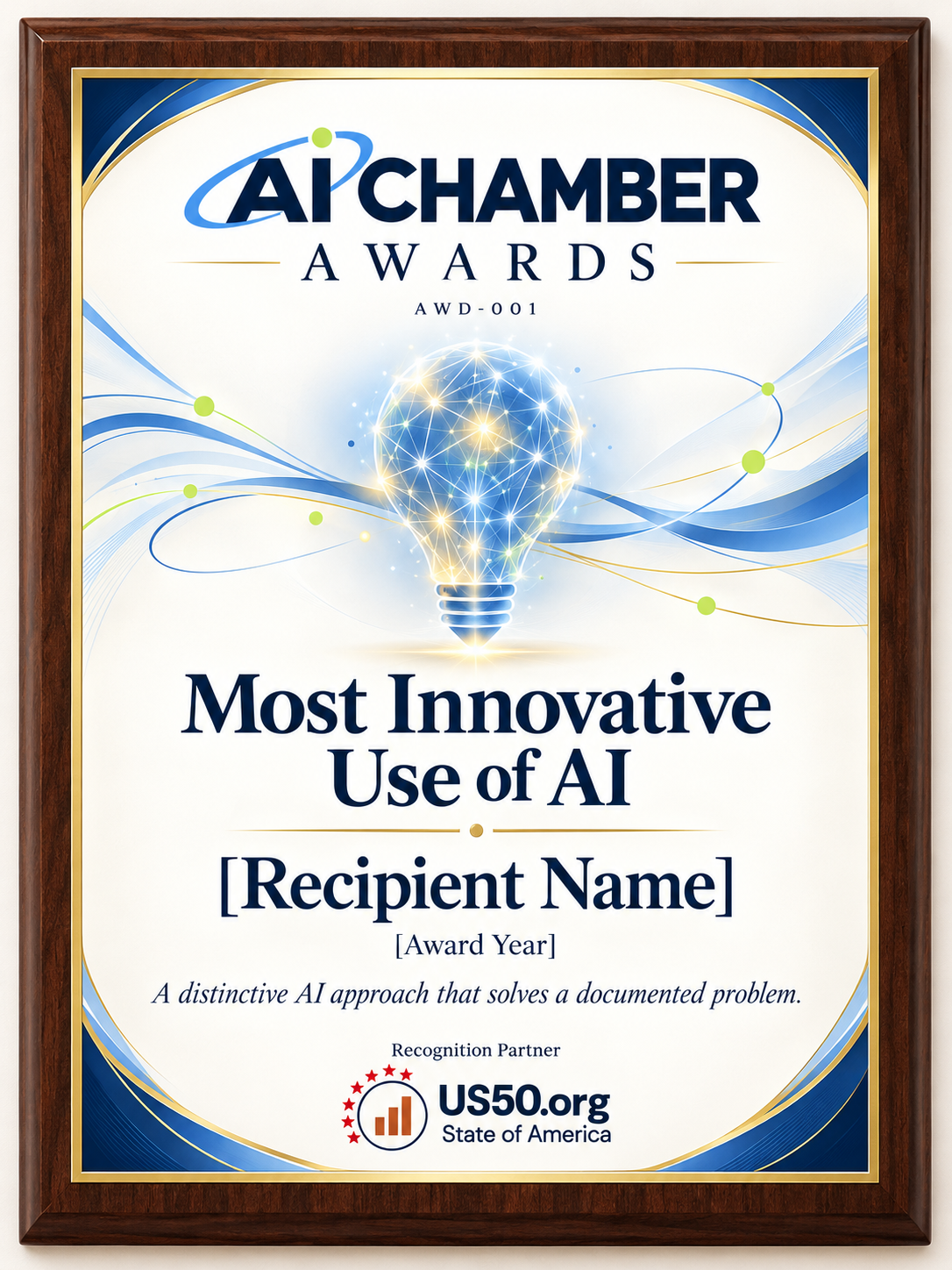
Most Innovative Use of AI award plaque design with recipient and year placeholders
Most Innovative Use of AIPlaque design · Recipient and year placeholdersView full-size design ↗

Latest recipient · June 2026 recognition

Google DeepMind’s AlphaFold team

For opening a new route to understanding protein structures and enabling scientific investigation on a remarkable scale.

Demis Hassabis and John Jumper, credited members of the AlphaFold collaboration.
Demis Hassabis and John Jumper, credited members of the AlphaFold collaboration. Image source: Google DeepMind ↗

Why the Chamber selected this recipient

An innovation that gives other people a place to begin.

The Chamber selected Google DeepMind’s AlphaFold team because its achievement reaches beyond a compelling demonstration. It gave scientific researchers a powerful new way to investigate a difficult problem: understanding how proteins take shape. The recognition of Demis Hassabis and John Jumper in the 2024 Nobel Prize in Chemistry provides an important historical marker for that contribution.

AlphaFold predicts a protein’s three-dimensional structure from its amino-acid sequence. DeepMind’s Nobel announcement reported that its freely available predictions had given more than two million scientists and researchers in 190 countries a tool for their work. The innovation therefore paired a new scientific capability with a practical route for other people to use it. That combination gives its impact a reach far beyond the original development team.

We recognize the AlphaFold collaboration, including Hassabis and Jumper, rather than presenting the achievement as the work of a single inventor. David Baker’s separately recognized protein-design work is not folded into this recipient record. Keeping those contributions clear matters when telling the history of innovation.

For a business reader, the lesson is about the reach of a useful breakthrough. An invention can create value by becoming a foundation for other people’s work. The most persuasive innovation story therefore explains both what changed in the approach and why that change opens a worthwhile possibility.

The Chamber’s recognition is for a documented scientific contribution. It does not promise that a predicted structure automatically becomes an effective medicine or replaces experimental investigation. The achievement is substantial without extending its claims beyond the evidence. That combination of ambition and clarity is why the team is the founding recipient of Most Innovative Use of AI.

Sources and recognition record

June 2026 founding recognition. Published 2026-10-28. The Chamber selected this achievement through editorial review of published sources. This was separate from paid nominations and public-support votes. Inclusion does not claim recipient acceptance, membership or endorsement.

Original country-linked story and research record →

The next chapter · July–December 2026

Who will be the next recipient of Most Innovative Use of AI?

Put a worthwhile achievement forward. Tell us the problem, how AI helped, what changed and who made it possible.

Most Innovative Use of AI

Nominate for Most Innovative Use of AI →

Apply by December 31, 2026, at 11:59 p.m. U.S. Central Time. $150 USD per paid nomination, including 12 months of Individual membership. Payment does not determine selection.

The form accepts one PDF or Word document and up to three photos. Read the awards rules, benefits and refund policy →

← Explore all 15 awards