

AI Innovation Awards · AWD-004

AI Education & Skills Leadership

Excellence in teaching people to understand, evaluate, and use AI.

What this award recognizes

The criteria

The learning program and skills gained are the achievement, rather than job placement.

  1. What can learners do better now?35 points
  2. Did the teaching fit the people learning?25 points
  3. Could learners use the skills afterward?20 points
  4. Are the learning results described fairly?10 points
  5. Did people learn to use AI responsibly?10 points
What to explain in your nomination

What can learners do better now?

Show improvement in understanding or practical skill. Comparable tasks before and after learning, examples of better work, or a clearly explained assessment can help. Tell us how many learners were assessed.

Did the teaching fit the people learning?

Share the learning goals, materials, examples, and approach. Explain how they matched the audience’s experience, needs, and circumstances.

Could learners use the skills afterward?

Show completed projects, workplace applications, or follow-up tasks. Include evidence that learners can evaluate AI output, and explain how much of the group you were able to follow up with.

Are the learning results described fairly?

Distinguish people enrolled, people completing, and people assessed. Explain how you checked performance, how accessible the learning was, and what feedback or missing follow-up tells you.

Did people learn to use AI responsibly?

Show how the instruction teaches checking answers, protecting private information, recognizing limitations and bias, being open about AI use, and keeping people accountable for decisions.

These five criteria total 100 points. The awards rules explain eligibility, evidence, review and selection. One principal achievement belongs in one category.

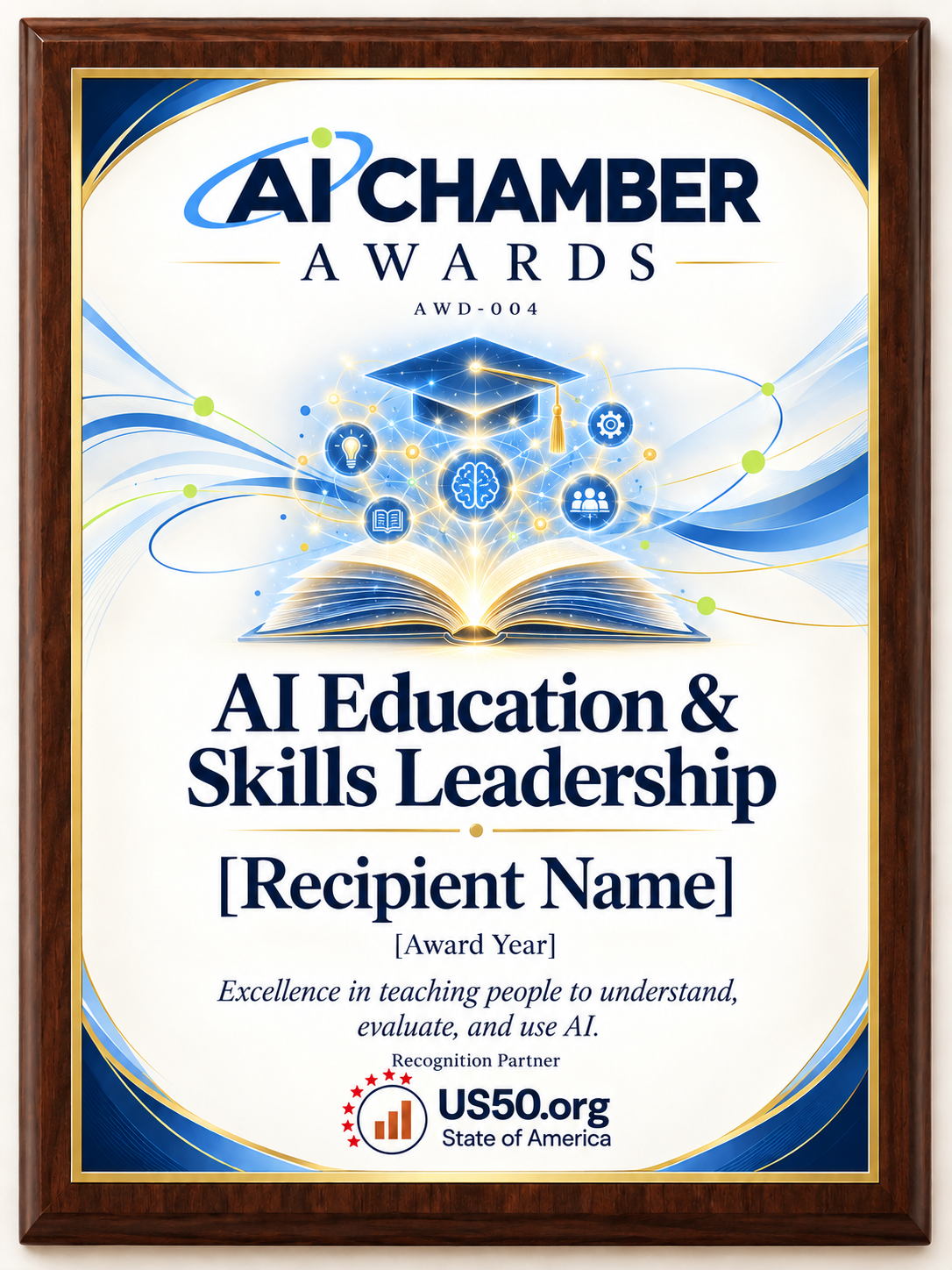
AI Education & Skills Leadership award plaque design with recipient and year placeholders
AI Education & Skills LeadershipPlaque design · Recipient and year placeholdersView full-size design ↗

Latest recipient · June 2026 recognition

Edo State educators and the World Bank AI tutoring pilot team

For showing how teacher guidance and AI-supported practice can help students build English and digital skills.

Students participating in the AI after-school program in Edo, Nigeria.
Students participating in the AI after-school program in Edo, Nigeria. Image source: SmartEdge / World Bank ↗

Why the Chamber selected this recipient

The teacher remains at the center of the learning.

The Chamber selected the Edo State educators and World Bank pilot team because they put AI into a real learning setting and examined what students learned. In the six-week Nigerian program, teachers guided students through English practice with Microsoft Copilot. The World Bank’s implementation account describes preparation, classroom guidance and reflection; its later evaluation account reports learning gains.

The implementation account describes 800 first-year senior secondary students attending after-school English classes twice a week during June and July 2024. Students practiced grammar and writing with AI while teachers guided the sessions. The later randomized evaluation assessed English, AI knowledge and digital skills and reported gains of about 0.3 standard deviations. The important connection is between a teaching experience people could actually deliver and learning they could assess.

The educators’ contribution is essential to the story. A useful tool still needs a purpose, appropriate prompts, guidance when learners struggle and someone helping them reflect on the answer. Recognizing the complete supported program gives credit to the people who made the technology part of an educational experience.

For employers and training providers, the lesson is immediately relevant. Begin with the skill a person needs, design opportunities to practice it, and decide how improvement will be assessed. The case invites a more useful conversation than simply counting the number of AI tools introduced into a classroom or workplace.

This was a pilot, and its results concern the supported intervention as a whole. They do not establish that any student using a chatbot alone will experience the same benefit, or that short-term gains settle questions about long-term learning. The Chamber recognizes a thoughtful, evaluated step forward and the educators who helped make it possible.

Sources and recognition record

June 2026 founding recognition. Published 2026-10-28. The Chamber selected this achievement through editorial review of published sources. This was separate from paid nominations and public-support votes. Inclusion does not claim recipient acceptance, membership or endorsement.

Original country-linked story and research record →

The next chapter · July–December 2026

Who will be the next recipient of AI Education & Skills Leadership?

Put a worthwhile achievement forward. Tell us the problem, how AI helped, what changed and who made it possible.

AI Education & Skills Leadership

Nominate for AI Education & Skills Leadership →

Apply by December 31, 2026, at 11:59 p.m. U.S. Central Time. $150 USD per paid nomination, including 12 months of Individual membership. Payment does not determine selection.

The form accepts one PDF or Word document and up to three photos. Read the awards rules, benefits and refund policy →

← Explore all 15 awards